
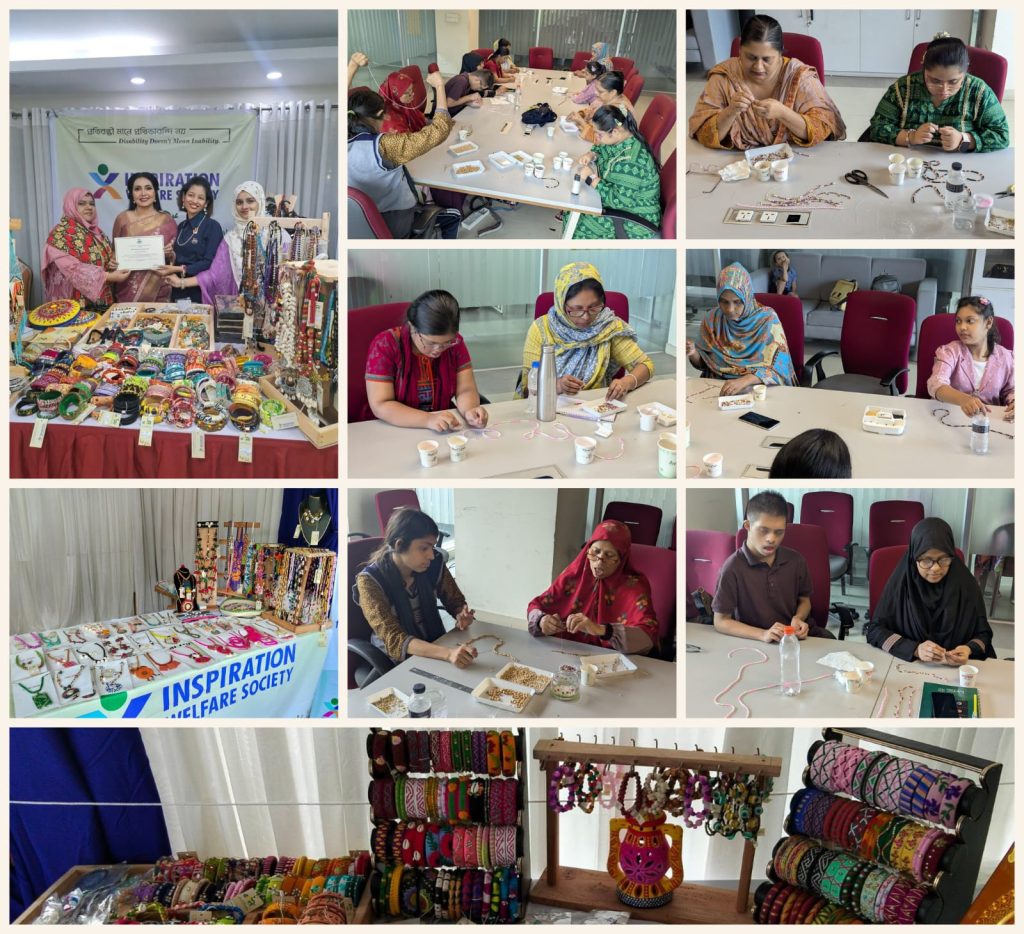
Inspiration Welfare Society proudly introduces a pioneering three-month jewelry making training program —the first of its kind in Bangladesh — where individuals with neurodevelopmental disabilities and their mothers train and create side by side. Rather than treating support as one-directional, this model builds on mutual collaboration: each product that emerges is the result of shared effort, patience, and creativity between mother and child.
This program is designed for individuals with autism, cerebral palsy, Down syndrome, intellectual disabilities, speech and hearing impairments, and other physical disabilities — along with their mothers, who train alongside them as equal partners.
Training sessions run twice a week, eight hours per day, over a three-month period. Participants learn directly from some of the country's most respected, experienced and well-known trainers in the field, ensuring high-quality, professional-grade skill development.
The goal of this program extends beyond skill-building. It is designed to create two entrepreneurs from every participating family — empowering both the individual with special needs and their mother to achieve self-employment, financial independence, and a distinct identity of their own.
To remove financial barriers, IWS provides direct financial support to underprivileged and struggling families for the purchase of raw materials, ensuring that economic hardship never stands in the way of opportunity.
Every product created through this program finds a home. IWS has established a dedicated platform — Barnali — where graduates can sell their handcrafted jewelry under the organization's banner, giving their work visibility, credibility, and a genuine pathway to sustainable income.
This program is more than vocational training — it's a movement toward dignity, inclusion, and self-reliance. By working together, mothers and children don't just learn a craft; they build confidence, strengthen their bond and step into the world as capable, independent entrepreneurs.
• Livelihood Development: Through jewellery-making training, persons with disabilities and their mothers will acquire income-generating skills, enabling them to become economically self-reliant.
• Social Inclusion: Training and employment opportunities will facilitate the meaningful inclusion of persons with disabilities into mainstream society.
• Brand Visibility through Impact: The project will highlight the participating organization's Corporate Social Responsibility (CSR) and positive social contributions, enhancing its reputation and brand value.
• SDG Alignment (SDGs 4, 8 & 10): The project will contribute to achieving SDG 4 (Quality Education), SDG 8 (Decent Work and Economic Growth), and SDG 10 (Reduced Inequalities).
• Inclusive Development: By ensuring the active participation of persons with disabilities and their families, the project will create equal opportunities for inclusive development.
• Disability Rights: The project will promote the rights of persons with disabilities through skill development, employment opportunities, and dignified participation in society.
• To ensure the economic empowerment and social inclusion of persons with disabilities through skill development, employment opportunities, and income-generating activities.
• To improve the overall quality of life of persons with disabilities by promoting sustainable livelihoods, self-reliance, empowerment, and active social participation.
• To provide jewellery-making skills training to 30 persons with disabilities and their 30 mothers within three months.
• To engage at least 50% of the participants in income-generating activities.
• To promote psychosocial development through creative and productive activities.
• To enhance participants' self-confidence and social skills.
➤ Participatory & Inclusive Approach
• Adopt a participatory and inclusive training methodology.
• Deliver training based on Individualized Training Plans (ITPs), considering each participant's abilities and specific needs.
• Ensure practical, experience-based learning through the Hands-on Learning Method.
• Create an accessible and effective learning environment using visual and sensory-based teaching methods.
➤ Rehabilitation-Oriented Approach
• Focus on the integrated development of vocational skills, behavioural development, and social development.
• Establish a strong Caregiver Support System by actively engaging family members, particularly mothers, throughout the training process.
➤ Market-Oriented Training
• Provide training on demand-driven jewellery design aligned with current market needs.
• Improve participants' skills in product finishing and packaging to enhance marketability and commercial value.
• Conduct Baseline and Endline Assessments to measure participants' initial and final status.
• Monitor monthly progress through Monthly Progress Tracking.
• Evaluate skill acquisition using Skill Performance and Progress Checklists.
• Monitor regular attendance throughout the training.
• Assess behavioural and social development through Behaviour Change Assessments.
• Prepare a Final Evaluation Report to assess the project's overall outcomes and impact.
• Track participants' income growth through Income Tracking to measure economic progress.
• Ensure donor logo visibility on all promotional materials, banners, posters, and publications.
• Promote project activities, success stories, and products through social media campaigns.
• Increase public awareness through print and electronic media coverage highlighting the project's achievements and social impact.
• Support product branding, exhibitions, and marketing to enhance the visibility and commercial potential of participants' products.
• Form production-based groups to facilitate collaborative production and income-generating activities.
• Adopt a Social Enterprise Model to ensure long-term financial sustainability.
• Strengthen online and local market linkages to expand market access and ensure regular product sales.
• Maintain project continuity through future donor engagement and the development of new strategic partnerships.
Risk Mitigation
Dropout Ensure regular participation and engagement through a strong caregiver support system.
Skill Variation Provide individualized training based on each participant's abilities and learning pace.
Market Risk Diversify products to meet varying market demands and reduce business risk.
Behavioural Challenges Provide continuous supervision, counselling, and regular support to effectively manage behavioural challenges.
• Ensure equal participation and opportunities for women and persons with disabilities.
• Maintain a safe, respectful, and inclusive learning environment for all participants.
• Encourage active family engagement throughout the training and rehabilitation process.
• Establish trained production groups comprising project participants.
• Enable participants to undertake independent production following project completion.
• Promote self-employment and entrepreneurship by supporting participants in establishing their own income-generating initiatives.
• Facilitate group-based enterprises under the guidance of the implementing organization.
• Strengthen market linkages to ensure sustainable product marketing and sales.
• Secure project sustainability through future funding diversification and the engagement of new donors and partners.
• Provide continued technical support, market access, and capacity-building assistance whenever required.